Center of Women’s Studies and Policies
Sofia 1000, 38 Tsar Asen street,
phone: ++359 2 981 04 73, E-mail: cwsp@cwsp.bg (+359 2) 980 6265, e-mail:cwsp@cwsp.bg

Equal Opportunities for Women and Men Monitoring Program
About the Program

The Program on Equal Opportunities for Women and Men in the European Accession Process (EOWM) is a joint initiative of the Open Society Foundation Romania and the Network Women’s Program of the Open Society Institute. Its conception stems from the Open Society Institute project to monitor the progress of candidate countries as they prepare themselves for integration into the European Union and ensure that they meet the Copenhagen political criteria, particularly in relation to the independence of the judiciary, minorities’ rights and anti-corruption. Given the acquis communautaire in the field of equal opportunities for women and men, which the countries in accession are required to adopt and comply with, an independent program to evaluate the status of accession countries from this perspective was developed.


An assessment of the status of equal opportunities, de jure and de facto, was carried out in seven of the candidate countries: Bulgaria, the Czech Republic, Estonia, Hungary, Lithuania, Poland and Romania, and the EU Directives on equal opportunities provided the framework for monitoring and analysing the corresponding legislation, institutions and practices. In 2002 was published the first report Monitoring the European Accession Process: Equal Opportunities for Women and Men. More about the Report, 2002


For more information about the first phase of EOWM/EONET Program you can visit www.eonet.ro


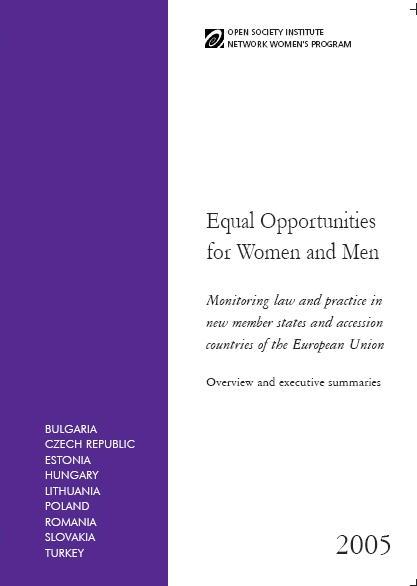
The CWSP continues its participation in EOWM/EONET Program of NWP and has prepared the second Monitoring Report for Bulgaria Equal opportunities for women and men: Monitoring law and practice in new member states and accession countries of the EU, 2005. More about the Report, 2005


Monitoring the EU Accession Process, 2002

During the first phase of the program (2001-2002) was published the first report Monitoring the European Accession Process: Equal Opportunities for Women and Men. An assessment of the status of equal opportunities, de jure and de facto, was carried out in seven of the candidate countries: Bulgaria, the Czech Republic, Estonia, Hungary, Lithuania, Poland and Romania, and the EU Directives on equal opportunities provided the framework for monitoring and analyzing the corresponding legislation, institutions and practices. The Directives related to the principle of equal pay for work of equal value; equal treatment as regards employment, protection of pregnant, breastfeeding women and women who recently gave birth, the burden of proof in cases of sex-based discrimination and non-discrimination against part-time workers were analyzed in 2001; while the remaining Directives on self-employed workers, parental leave, and social security schemes were assessed in 2002.


The Program Director, with the assistance of an expert working group comprised of experts from Western and Eastern Europe, devised the methodology based on the content of the EU Directives and EU case laws. The experts were also charged with supervising the completion of the Monitoring Reports by the national experts. Questions related to each specific Directive were issued, addressing key aspects from a legal, conceptual and factual point of view. The research was carried out in each candidate country by teams of local experts from various backgrounds: lawyers, sociologists, scholars, women’s rights advocates from local NGOs or international agencies or from trade unions. Throughout the project, debates were organized within each country to enable a discussion and critique of the draft reports, sections of which were discussed with different constituencies and presented to the European Commission.


The findings of the reports illustrate how women’s human rights and equal opportunities for women and men are perceived in the candidate countries, all of whom have undertaken several steps in order to comply with EU standards, adopting a host of new laws and in most cases amending their Labor Codes. The overall assessment is that the EU accession is a positive process for raising social standards, and standards on gender equality in particular. The process has primarily influenced legislation in the field of employment, specifically equal pay and access to employment, the establishment of gender equality institutions and special legislation. The shift in the burden of proof and the adoption of provisions on parental leave provisions can be seen in some countries, as can the removal of certain measures that claim to be protective towards women, but which are in fact discriminatory.


This critical assessment is valid despite the fact that as of June 2002 all of the countries under review had already closed Chapter 13 “Employment and social policy” of the negotiation process. The Chapter was closed with certain conditions dictated by the Commission for these countries, including in the field of gender equality. The fulfillment of these conditions must be thoroughly monitored by the European Commission, the European Parliament and the NGOs in the countries in accession.


The country reports published in the fall of 2002 contain the latest information available as of 15 July 2002 and provide concrete recommendations on how to ensure full compliance with all of the Directives and outlines specific areas of concern.


The elaboration of the first report for Bulgaria was coordinated by the European Institute Foundation and the working group included a variety of experts from the state administration and the non-governmental sector. The report for Bulgaria presents the main findings as well as recommendations for the implementation of each Directive.


The full report for all countries, the report for Bulgaria as well as the introduction and overview in English can be found below.

 Introduction.pdf(93.33 Kb)

  Overview.pdf(284.9 Kb)

  Bulgaria.pdf(327.08 Kb)

  BulgariaES.pdf(108.84 Kb)


Monitoring law and practice in the new member states and the accession countries of the EU, 2005


The second monitoring report Equal opportunities for women and men: Monitoring law and practice in new member states and accession countries of the EU, 2005, was prepared in the framework of the Network Women's Program "Bringing the EU Home" Project. This is a three year project (2004-2006) which aims to promote awareness, advocacy and enforcement of equal opportunity legislation at the national level and to build the capacity of national actors in civil society to use EU-level mechanisms effectively. The findings and recommendations in Equal Opportunities for Women and Men are based on monitoring conducted by national gender equality experts and local NGO representatives in Bulgaria, the Czech Republic, Estonia, Hungary, Lithuania, Poland, Romania, Slovakia, and Turkey.


The aim of the report is to cover all aspects and present the actual picture of the status of equal opportunities for women and men by comparing 2002 and 2005.


The report describes the changes in the existing legislation and national institutional mechanisms, policies, and programs on gender equality, and highlights several shortcomings. The research identifies a general lack of awareness among men and women about how gender inequality affects their daily lives as well as a lack of political will to enforce existing national and EU gender equality policies.


KEY RECOMMENDATIONS


Legislation

  • A law on the equal treatment for women and men in addition to the Law on Protection against Discrimination to be adopted.


Institutional mechanisms

  • Special sub-committee on equal treatment for women and men to be created within the Human Rights and Religious Affairs Committee of the National Assembly;
  • Experts in gender issues to be appointed with each Ministry;
  • Experts in gender issues to be appointed with each Municipality.
  • To provide the necessary financial resources for the establishment of the relevant institutions.


Policies and Programs

  • To be developed a National strategy on equal opportunities for women and men.


Research and Statistics

  • Gender indicators should be prepared so that the National Statistical Institute and the executive can collect and process statistical data disaggregated by gender to monitor gender equality and develop policies.

THE FULL REPORT FOR BULGARIA IN ENGLISH: Country_Report_Bulgaria.pdf (799.1 Kb)


Below you can find texts from the Report in English:


Introduction:Introduction.pdf (93.33 Kb)

Overview: OVERVIEW.pdf (97.92 Kb)

Executive Summary for Bulgaria:_2BULGARIA.pdf (68.04 Kb)

Acknowledgements:preface_acknow.pdf (88.44 Kb)


Below you can find the full Report in English:


intro.zip (345.2 Kb)

executive_summaries.zip (533.75 Kb)

country_reports.zip (6.05 Mb)


Materials from the official launch of the Report in the EU Parliament – Brussels, 4 May 2005.


Fact Sheet for Bulgaria:Bulgaria_FS.pdf (44.16 Kb)

Brochure:1_BROCHURE_OK.pdf (72.35 Kb)


Copyrights © 2003
Center of Women’s Studies and Policies